
The 1902 Indian Head Penny belongs to the "Indian Head" series produced by the United States Mint between 1859 and 1909.
This specific issue is characterized by a significant production volume totaling 87,374,704 specimens.

All 1902 coins were manufactured exclusively at the main Philadelphia facility, having no mint marks on the reverse.
Making a decision regarding selling or keeping requires a detailed study of the coin's physical condition and current market situation.
The parameters of the 1902 coin are identical to the standards adopted for bronze cents after 1864.
The alloy composition ensures high durability while allowing natural surface color changes under environmental influence.
Parameter | Value |
Weight | 3.11 grams |
Diameter | 19.00 mm |
Composition | 95% copper, 5% tin and zinc |
Edge Type | Plain |
Designer | James B. Longacre |
The stated weight may deviate by 0.10 grams downward resulting from wear during the circulation process.
State Classification by Color Categories
The market price of copper coins depends directly on the preservation degree of the original mint luster.
Numismatic standards distinguish three primary color groups determining the final grade.
Brown (BN). Surfaces being entirely brown and having lost all luster.
Such coins constitute approximately 90% of the surviving mintage.Red-Brown (RB). Surfaces having retained between 5% and 95% of the original copper color.
The presence of orange-red areas significantly increases the estimated value.Red (RD). A coin having preserved more than 95% of its initial luster.
This category serves as the main target for investment holding.
Transitioning from the RB to RD category in MS65 grade increases the lot price by an average of 140%.
Auction Records and Peak Price Statistics
Pricing for 1902 coins demonstrates a sharp jump upon reaching the highest scores on the Sheldon scale.
Record sales are recorded exclusively for specimens in Mint State (MS) condition.
MS66 RD: The average price varies within the 450–650 USD range.
MS67 RD: The value reaches 2,500–4,000 USD.
MS67+ RD: An exceptional rarity for this issue.
An auction record was established in 2021 at Heritage Auctions.
A 1902 coin in MS67+ RD grade was realized for 21,600 USD.
The high price resulted from the total absence of contact marks and flawless detailing of the feathers in the headdress.
Value Dynamics and Market Trends
Analyzing market data over the last 10 years allows for identifying value change patterns.
Price fluctuations depend on the rarity of a specific grade in Population Reports.
Grades up to MS63: The price remains stable, increasing by 1.5–2% per year, barely covering inflation.
Grades MS64–MS65: An annual growth of 4.5% is observed resulting from the depletion of high-quality coins in open circulation.
Grades MS66 and higher: These are characterized by volatility up to 15% per year, being dependent on the appearance of new top specimens on the market.
In percentage terms, owning a coin in low condition (G-VG) brings no profit as supply exceeds demand.
Rarity Assessment
Population reports from certifying agencies like the coin appraisal app confirm the distribution structure of surviving coins.
For 1902, the indicators appear as follows.
Grade | PCGS Quantity (RD) | NGC Quantity (RD) |
MS64 RD | 845 | 412 |
MS65 RD | 512 | 285 |
MS66 RD | 158 | 72 |
MS67 RD | 14 | 5 |
The total number of coins in MS67 RD condition stands at fewer than 20 units worldwide.
This fact makes selling such a specimen justified only during periods of peak auction demand.
Criteria for Decision Making
Determining the further holding strategy requires performing a step-by-step characteristic check with the coin value app.
Checking the LIBERTY inscription. The presence of all four letters in good quality classifies the coin as Fine (F) or higher.
Lacking inscription readability, the coin should be sold at base bullion or common material price (1–3 USD).
Feather tip analysis. Preserving sharp lines on the feather tips indicates Extra Fine (EF) condition.
Such samples possess potential for price growth assuming the absence of cleaning traces.
Identifying cleaning signs. Using abrasive substances or acids to "improve" appearance reduces value by 70–90%.
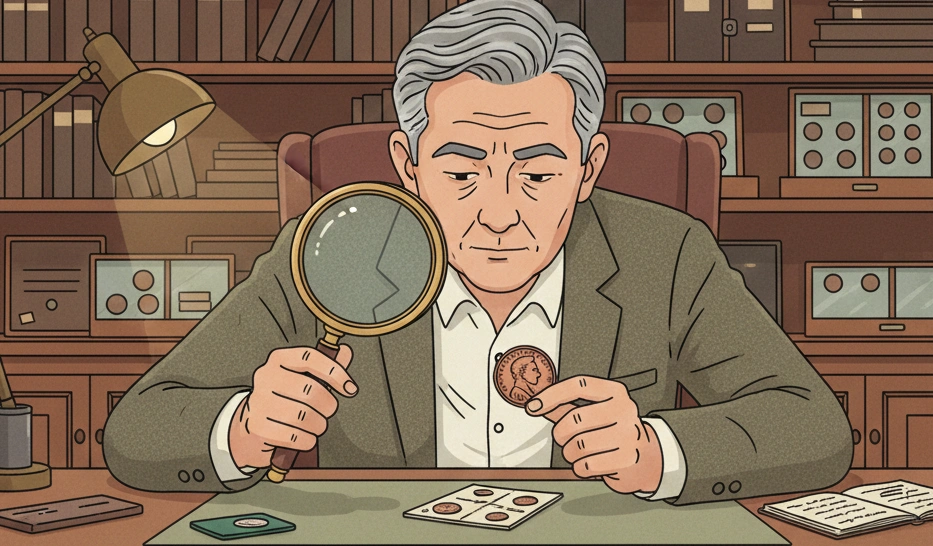
Cleaned coins possess no investment value, being subject to immediate liquidation.
Minting Errors and Their Impact on Value
A limited number of production defects were recorded in 1902.
Errors confirmed by experts are valued separately from standard price lists.
Repunched Date (RPD): Repeated punching of the date digits with an offset.
The value of a specimen in AU condition increases by 30–50 USD compared to a regular sample.Off-Center Strike: Minting with an offset exceeding 10%.
The price starts at 150 USD, increasing proportionally to the image displacement percentage.Die Cuds: Metal blobs caused by die edge failure.
Such coins are valued individually, often reaching prices of 50–100 USD.
These deviations make the coin unique, justifying its long-term holding in anticipation of a specialized buyer.
Condition | Brown (BN) | Red (RD) |
Good (G4) | $2 | — |
Fine (F12) | $5 | — |
EF40 | $15 | — |
MS63 | $45 | $110 |
MS65 | $140 | $340 |
Statistics show that the gap between BN and RD in the MS65 grade totals nearly 250%.
Value Forecast for 2026–2030
Analyzing market cycles suggests the continuation of current interest in the Indian Head series.
The expected reduction in the supply of MS65 RD coins by 3% annually will create a deficit in the high-price segment.
Prices for low-quality coins will remain static resulting from the excessive quantity of surviving specimens.
Investing in 1902 coins is justified only when purchasing specimens with a grade above MS66.
Selling coins in condition below Fine is advisable for capital release, as storage costs may exceed the annual value growth.
The 1902 penny remains a common yet sought-after coin assuming high quality.
The decision to sell should be based on the absence of rare grade signs or unique minting errors.
Holding is justified for specimens possessing original red luster and having no visible field damage.
Studying population reports allows for avoiding mistakes during rarity assessment, ensuring an economically sound decision.
A thorough inspection of small die details performed using modern equipment remains the only way for accurate value verification.